
Tools & Materials Required
Safety Notes
- Retain failed bearing and lubricant samples for analysis -- do not discard evidence
- Photograph the bearing in-situ before removal
- Label all components with their position (drive end / non-drive end)
1. ISO 15243 Failure Mode Classification
The ISO 15243 standard classifies bearing damage into six primary modes. Understanding these categories helps you systematically identify what happened and why.
| Mode | Sub-Types | Visual Clue | Primary Cause |
|---|---|---|---|
| Fatigue | Sub-surface, surface-initiated | Spalling (flaking) of raceway surface | Normal end-of-life, overload, or material defect |
| Wear | Abrasive, adhesive, corrosive | Material removal, polished surfaces, scoring | Contamination, inadequate lubrication |
| Corrosion | Moisture, fretting, false brinelling | Red/brown staining, etching, pitting | Water ingress, vibration in stationary bearing |
| Electrical erosion | Excessive current, current leakage | Fluting (washboard pattern), craters | VFD-driven motors, improper grounding |
| Plastic deformation | Overload, indentation | Brinell marks matching rolling element spacing | Shock loads, improper handling/mounting |
| Fracture | Forced, fatigue, thermal | Cracked rings, broken cage | Excessive preload, impact, overheating |
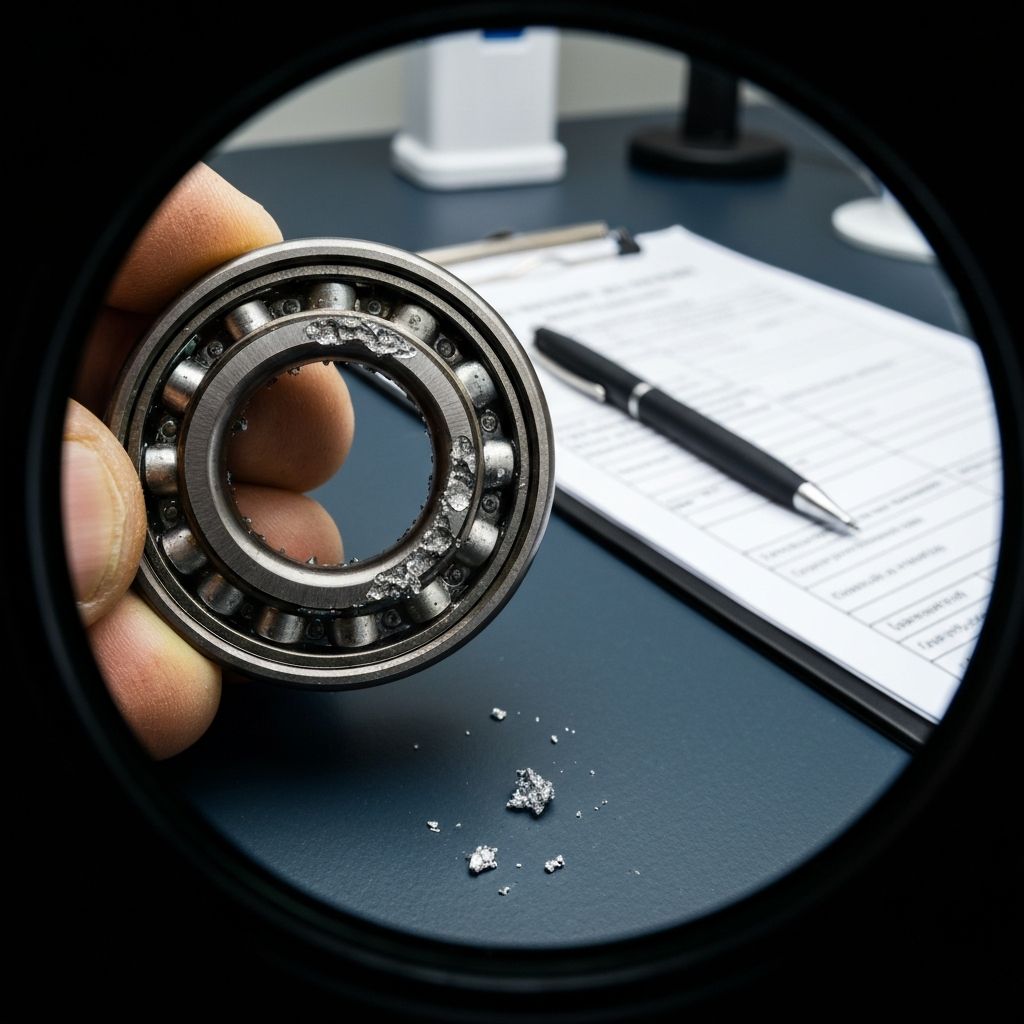
2. Fatigue Spalling Analysis
Spalling is the most common failure mode. The location and pattern of spalling reveals the root cause:
- Inner ring, full circumference -- Normal fatigue end-of-life under rotating inner ring load. The bearing simply reached its calculated L10 life.
- Inner ring, one zone only -- Point load from misalignment or shaft deflection. The load zone never rotates, concentrating fatigue in one area.
- Outer ring, one zone (bottom) -- Normal for stationary outer ring with radial load. Check if the spall size matches the expected L10 life; if premature, investigate overloading.
- Outer ring, circumferential band -- Indicates the outer ring is creeping (rotating) in the housing due to loose fit. The entire circumference sees load.
3. Contamination-Related Damage
In UAE industrial environments (cement, construction, oil & gas), contamination is responsible for an estimated 40--50% of all premature bearing failures.
Identifying Contamination Damage
- Dull gray raceways with thousands of tiny dents -- hard particle contamination (sand, cement dust, metal swarf)
- Blackened or dark grease with gritty texture -- indicates abrasive particles have been working through the contact zone
- Accelerated wear on cage (thinning, distortion) -- abrasive particles erode the softer cage material faster than the hardened rings
Prevention Measures
- Upgrade to multi-barrier sealing systems (see our seal selection guide)
- Switch to sealed bearings (2RS suffix) where speed ratings allow
- Implement clean mounting practices in a controlled area, not on the open shop floor
- Use filtered breather caps on gearbox housings
4. Electrical Erosion (VFD-Related)
With the increasing use of Variable Frequency Drives (VFDs) in UAE industrial facilities, electrical erosion has become a growing failure mode. Stray currents pass through bearings, creating characteristic damage patterns.
Fluting Pattern
Repeated electrical discharges across the lubricant film create a washboard-like pattern of parallel grooves on the raceway. This is called fluting and is unmistakable once you know what to look for.
Prevention
- Install shaft grounding brushes (copper or carbon fiber) on VFD-driven motors
- Use electrically insulated bearings (ceramic-coated outer ring, e.g., SKF INSOCOAT or hybrid ceramic bearings)
- Ensure proper VFD cable shielding and grounding per manufacturer specifications
- Use common-mode filters at the VFD output
5. Systematic RCA Investigation Process
Photograph the bearing, housing, shaft, seals, and lubrication condition before dismounting. Record operating hours, last maintenance date, and any reported symptoms (noise, vibration, temperature).
Collect a grease sample in a clean container. Keep the failed bearing unwashed. Photograph the shaft and housing bore surfaces.
Use ISO 15243 categories. Is it fatigue, wear, corrosion, electrical, deformation, or fracture? The mode points to the root cause category.
Where on the ring? Full circumference or one zone? Inner ring or outer ring? The pattern reveals whether the cause is load, fit, alignment, lubrication, or contamination.
Address the root cause, not just the symptom. If contamination is the cause, replacing the bearing alone guarantees repeat failure -- fix the sealing system.
Pro Tips
- 1Build a photo library of failed bearings categorized by failure mode -- it accelerates future diagnoses
- 2Always compare the calculated L10 life against the actual service life to determine if failure was premature or expected
- 3When sending bearings to the manufacturer for analysis, never clean them -- the lubricant condition is critical evidence
Important Warnings
- Do not reuse a bearing that shows any sign of spalling, corrosion, or cage damage -- even minor damage accelerates rapidly
- Never assume electrical erosion is absent just because the motor is not VFD-driven -- stray currents from welding equipment and unbalanced phases can also cause fluting
Related Topics
Related Products
Continue Learning