
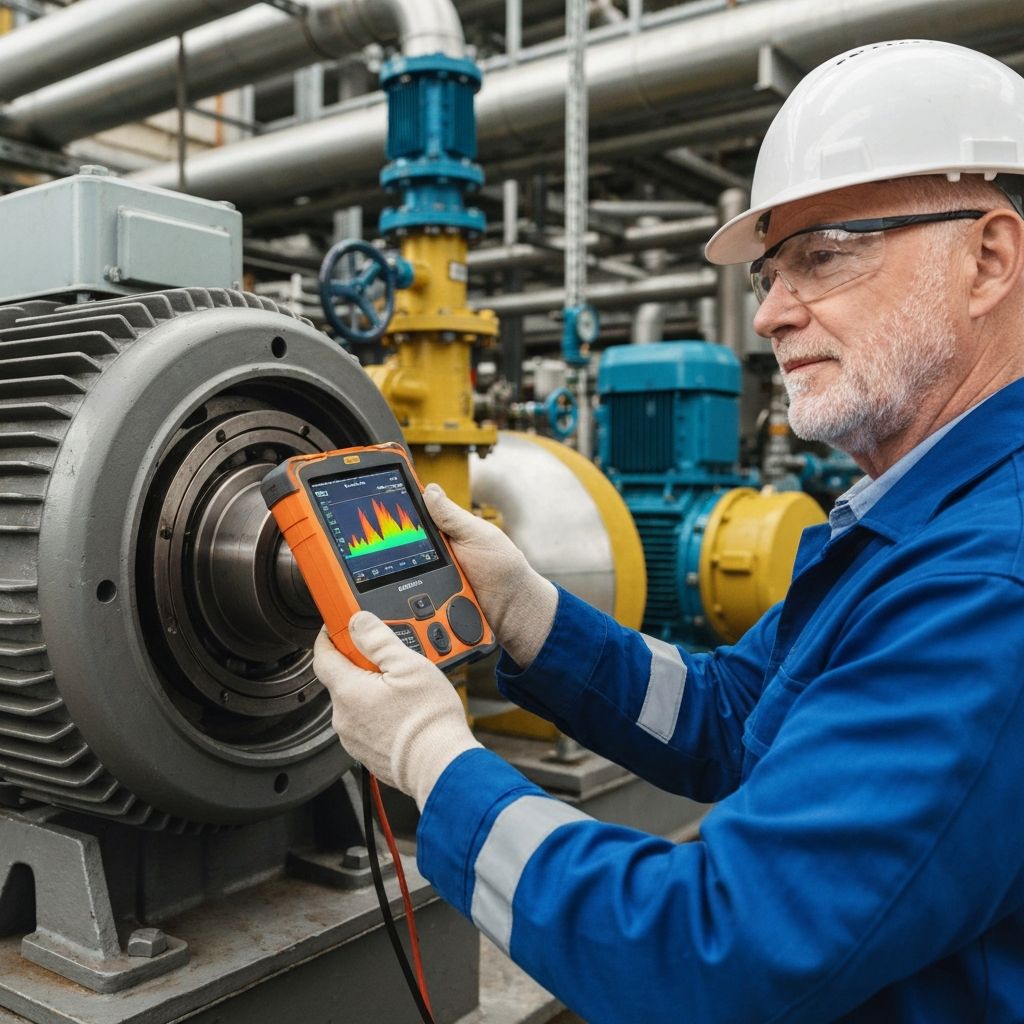
Tools & Materials Required
Vibration analyzer/data collector (SKF Microlog, Fluke 810, or equivalent)Accelerometer with magnetic mountIR temperature gun or contact thermocoupleStroboscope (optional, for visual speed verification)
Safety Notes
- Never touch rotating equipment during measurement -- use magnetic-mount sensors only
- Ensure measurement points are on solid metal surfaces, not on guards or covers
- Follow lockout/tagout procedures if sensor placement requires proximity to moving parts
1. Why Condition Monitoring Matters
A bearing does not fail without warning. The progression from initial defect to catastrophic failure follows a predictable timeline:
| Stage | Remaining Life | Detection Method | What You Observe |
|---|---|---|---|
| 1. Sub-surface crack | 10--20% of remaining life | Ultrasonic / Acoustic Emission | Nothing audible or visible |
| 2. Micro-spalling | 5--10% of remaining life | Vibration (envelope analysis) | Slight increase in high-frequency vibration |
| 3. Visible spalling | 1--5% of remaining life | Vibration (velocity), temperature rise | Audible noise, measurable heat increase |
| 4. Catastrophic failure | 0% | Obvious | Seizure, smoke, machine stop |
The Value Proposition Detecting a fault at Stage 2 gives you weeks to months of lead time to order a replacement bearing and schedule a planned shutdown. Waiting until Stage 4 means emergency downtime, secondary damage to shafts/housings, and 5--10x higher total repair cost.
2. Vibration Measurement Fundamentals
Vibration is measured in three parameters, each useful at different stages:
- Displacement (microns) -- Low-frequency faults: unbalance, misalignment, looseness. Measured below 100 Hz.
- Velocity (mm/s RMS) -- The most general-purpose measurement. ISO 10816 alarm levels are defined in velocity. Covers 10--1000 Hz.
- Acceleration (g) -- High-frequency faults: bearing defects, gear mesh problems, cavitation. Covers 1--20 kHz.
ISO 10816 Alarm Thresholds
| Machine Class | Good | Satisfactory | Unsatisfactory | Unacceptable |
|---|---|---|---|---|
| Class I (small machines < 15 kW) | < 0.71 | 0.71--1.8 | 1.8--4.5 | > 4.5 mm/s |
| Class II (medium 15--75 kW) | < 1.12 | 1.12--2.8 | 2.8--7.1 | > 7.1 mm/s |
| Class III (large, rigid foundation) | < 1.8 | 1.8--4.5 | 4.5--11.2 | > 11.2 mm/s |
3. Bearing Defect Frequencies
Each bearing component generates a characteristic vibration frequency when damaged. Calculating these frequencies and looking for them in a vibration spectrum confirms which component is failing.
- BPFO (Ball Pass Frequency Outer) -- outer ring defect
- BPFI (Ball Pass Frequency Inner) -- inner ring defect
- BSF (Ball Spin Frequency) -- rolling element defect
- FTF (Fundamental Train Frequency) -- cage defect
Practical Shortcut You do not need to memorize these formulas. Bearing manufacturers (SKF, JTEKT, NTN) provide free online calculators and databases where you enter the bearing designation and speed, and it outputs all four defect frequencies. Use these to set up your vibration analyzer's bearing database.
4. Temperature Monitoring Guidelines
Temperature is the simplest and cheapest condition monitoring parameter. A bearing running hotter than normal indicates increased friction from one of several causes.
Temperature Alarm Guidelines
| Condition | Temperature | Action |
|---|---|---|
| Normal operating | 40--70 C (depending on application) | Continue monitoring |
| Warning | 70--90 C | Increase monitoring frequency, investigate |
| Alarm | 90--110 C | Plan shutdown, inspect bearing and lubrication |
| Danger | > 110 C | Immediate shutdown -- risk of seizure |
UAE Ambient Temperature Correction In summer months when ambient temperatures reach 45--50 C, the bearing operating temperature will be proportionally higher. Set your alarm thresholds relative to a baseline measured during commissioning, not to absolute values.
Pro Tips
- 1Establish a vibration baseline for each machine immediately after commissioning or bearing replacement -- this is your 'healthy' reference
- 2Trend the data monthly for critical equipment, quarterly for general equipment
- 3Invest in online monitoring (permanently mounted sensors with wireless data transmission) for critical and hard-to-access bearings
Important Warnings
- Do not rely on temperature alone -- by the time a bearing is hot, significant damage has already occurred
- Vibration readings from a guard or cover are unreliable -- always measure on the bearing housing directly
Related Topics
bearing vibration analysiscondition monitoring bearingpredictive maintenance bearingbearing temperature monitoringSKF Micrologbearing defect frequencyISO 10816 vibrationbearing envelope analysis
Related Products
Continue Learning